 Call Now
Representative Assessee – Meaning, Types, and How to Appoint
Representative assessee refers to a person or an entity having a right to file the Income tax returns of another person. The relevant provisions are covered under sections 303 to 305 of the Income Tax Act, 2025.
Key Highlights
Terms used:
- Representative assessee - is the person who acts on behalf of the principal assessee.
- Principal assessee - is the person on whose behalf representative asessee files ITR, appears for hearings, pays taxes and entitled to receive refund.
What is a Representative Assessee?
Representative assessees are those who are legally permitted to file the Income Tax Returns of the other person (hereinafter referred to as the principal assessee).
On possession of certain documentary evidence, the representative assessee can register themselves on the Income Tax Portal, and file the ITR of the principal assessee.
This concept usually arises in situations where the assessee cannot file their ITR by themselves, due to various reasons.
Who needs a Representative Assessee?
In the following situations, a representative assessee can be appointed.
Non-Resident
- A non-resident, as per section 9 of the Income Tax Act 2025, may or may not be able to attend to all his income tax compliances in India.
- In such situations, through a written contract, he may appoint his agent as a representative assessee.
- The Income Tax Authorities also have the power to appoint a person as an agent of a non-resident as a representative assessee.
- In such situations, a person will be treated as an agent if they satisfy any of the conditions:
- They are employees of the non-residents
- They have a business connection with the non-resident
- They are a trustee of a non-resident
- They receive or are supposed to receive any income from a non- resident.
In the above situations, the person will not be treated as a representative assessee, unless they are given an opportunity to be heard.
In a nutshell, non-residents can either appoint a representative assessee under an explicit contract, or the department can appoint one if it deems tax correspondence and recovery difficult.
Note: Except in the case of an agent of a non-resident, an explicit contract to act as a representative on tax matters is not required.
Assessees who are Minors, mentally ill, or a person of Unsound Mind
- The guardians or the manager who receives the income on behalf of a minor, a person of unsound mind, or a mentally ill person shall be the representative assesse for such persons.
- In the aforementioned case, the appointment of a representative assessee is mandatory as per the income tax provisions, not optional.
Beneficiary to a Trust
- In such situations, the trustee appointed in the trust, who is entitled to receive the income on behalf of the beneficiary, is considered the representative assessee.
- If there is more than one trustee, then all the trustees shall be representative assessees.
- Irrespective of whether the trust is in writing or an oral trust, or just receives income on behalf of another person, such a person receiving income on the other’s behalf is considered a representative assessee.
Deceased Persons
- The legal heir of a deceased person shall be their representative assessee.
Representative Assessee in PAN Application
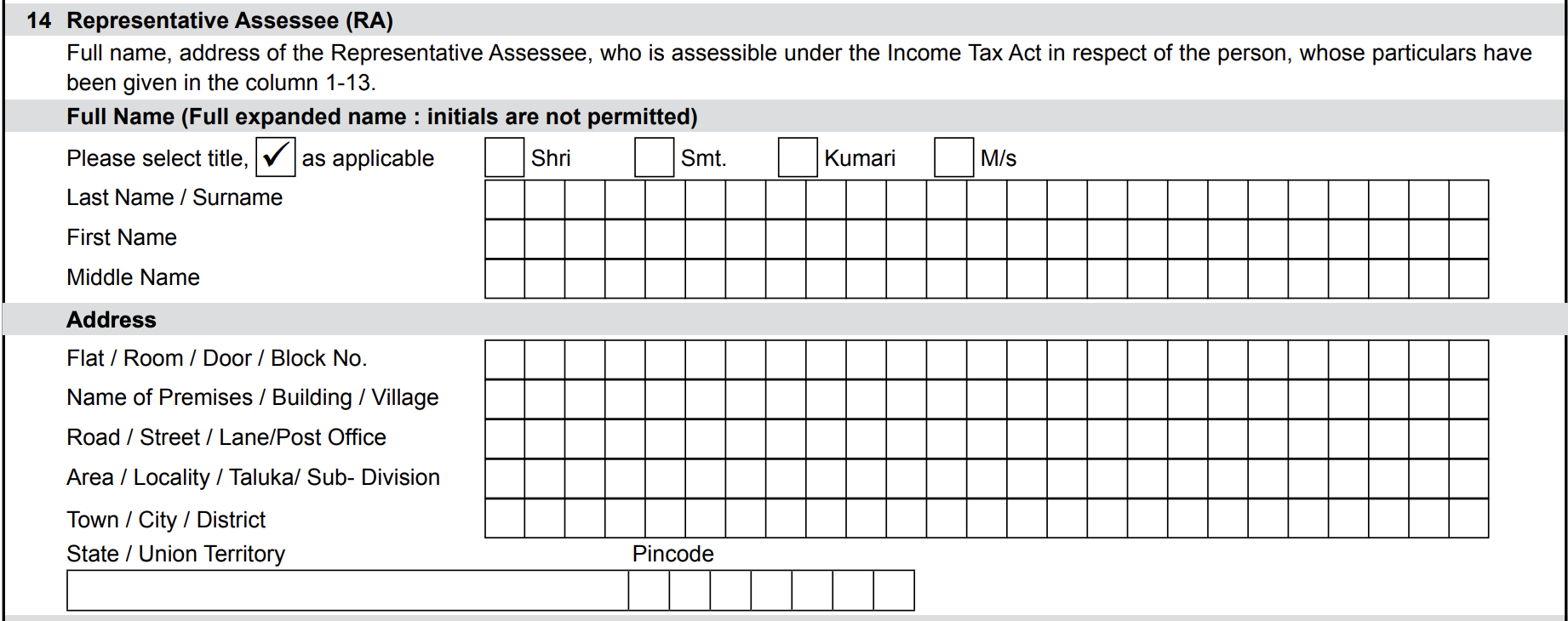
- For application of PAN, the principal assessee should give the details of the representative assessee in Form 49A (Form 93 and 94 of the Income Tax Rules, 2026).
- A representative assessee can make an application for a allotment of PAN. This situation is relevant where the principal assessee is not in the capacity to apply for a PAN themselves.
- Details like name and address of the representative assessee is required for PAN application.
A snippet of details needed to be filled in Form 49A is given below:
Documents Required to Register as a Representative Assessee
- As per the new Income Tax Rules 2026, the following details of the representative assessee are required for application of PAN:
- Proof of Identity
- Proof of Address
- Proof of Date of Birth/Date of Incorporation.
How to appoint a Representative Assessee?
- Log in to the Income Tax Portal
- Go to ‘Let’s get started’ > ‘Create a new request’
- Under ‘Category of assessee you want to represent’, choose ‘Representative assessee’.
- Accurately fill in the particulars, and upload documents
- Proceed to verify and submit the request.
Responsibilities and Duties of a Representative Assessee
The representative shall be liable to comply with all the provisions of the Income Tax Act, as if income is earned or received by themselves. This includes
- Duly file ITR and pay income tax on income earned in representative capacity.
- Appear for assessment, provide necessary information to the Income Tax Authorities to to support asssessment procedures.
- Deduct TDS, collect TCS within cut off dates and duly remit it to the government.
- Maintain accurate books of accounts as prescribed, wherever required under the provisions of the act.
However, the income tax authorities have the power to assess the principal assessee, if they deem fit.
Rights of a Representative Assessee
- Right to receive refund.
- Right to appeal, if they receive assessment order against their favour.
- In case of disput between principal assessee and representative assessee, they can approach the department, and the representative assessee can settle the dues as mentioned in the certificate of liability, as provided by the income tax authority.
Difference Between Representative Assessee, Deemed Assessee, and Assessee-in-Default
| Type of Assessee | Description |
| Representative assessee |
|
| Deemed Assessee |
|
| Assessee-in-default |
|
Final Word
This concept is beneficial to both the department and the assessee, since it bridges the gap of compliance execution, from both the department’s side and the assessee’s side.



Cleartax is a product by Defmacro Software Pvt. Ltd.

ISO 27001
Data Center

SSL Certified Site
128-bit encryption