|


Sea IGM Tracking & Enquiry: How to Check Sea IGM Status on ICEGATE?
IGM is the first mandatory import checkpoint. Without it, cargo cannot legally enter or be processed in Indian ports. With global trade expanding rapidly, tracking imports has become critical. In India, this is done through the ICEGATE portal using the Import General Manifest (IGM). Continue reading to get a comprehensive overview of IGM tracking and enquiry in import compliance.
Key Takeaways
- Sea Import General Manifest is a mandatory document required by the customs which provides detailed insight into the import of goods and cargo entering the country.
- IGM should be filed in the ICEGATE portal before the arrival of the vessel, generally within 24 hours of the vessel reaching the Indian Port.
- The Bill of Entry (BOE) is thereafter filed to legally declare imported goods to customs and seek permission to clear them in India.
- The ICEGATE portal provides a centralised platform to track the status of Sea IGM using unique credentials such as the IGM number, Bill of Lading number, or vessel details.
- The status tracking facility of Sea IGM helps in identifying errors at the early stages itself, reducing the possibilities of demurrage, detentions or penalties, and it also acts as a security check to avoid illegal imports, smuggling, etc.
What is Sea IGM?
Sea IGM stands for Sea Import General Manifest. It is a document required by customs authorities which contains detailed information about the cargo entering a country.
Mandated under the Customs Act, 1962, IGM is the first legal step for cargo entry, enabling customs clearance, tax assessment, and regulatory compliance.
Such documents contain details about the shipment, including the shipper’s name, consignee’s name, the description of goods, the quantity and other relevant details.
The main purpose of this document is:
- It is a legal declaration that informs Customs that a vessel carrying import cargo has arrived in India.
- Customs can begin the process of verification, risk assessment, examination and clearance procedures only after the IGM is filed.
- IGM acts as documentary evidence that goods entered India.
What is Sea IGM and How Does it Work?
Sea IGM tracking is the process of monitoring the status of the IGM from the time it is shipped in a foreign port till it arrives at the relevant Indian port.
The tracking system helps the importers, customs officers, and shipping agents to know whether the cargo has been officially declared to customs and whether it is ready for clearance.
The process of tracking is done through the ICEGATE (Indian Customs Electronic Gateway) portal.
Here is how the basic tracking process works:
- Before the shipment arrives in India, the shipping line files the IGM details to Indian Customs through the ICEGATE portal.
- Then the IGM details are verified by the customs, which checks the bill of lading, vessel details, consignee details, etc. After verification, customs may accept the IGM or raise errors or ask to make amendments if the data is incorrect.
- After such verification, the importer or the customs agent can track a particular import using the IGM number or the bill of lading number and check whether the IGM is filed, the status of the IGM (accepted/ rejected/ pending for approval) and whether the cargo is listed for clearance.
- The sea IGM is generally filed within 24 hours before the vessel arrives in India.
The tracking process thoroughly helps you to ensure that your cargo is officially declared, by preventing any clearance delays and gives visibility on vessel & cargo arrival processing.
Why is Sea IGM Tracking Important?
The process of Sea IGM tracking becomes crucial as it ensures a smooth, legal and timely clearance report.
- The tracking process confirms that IGM is filed, and the goods being imported are officially reported to the Customs.
- Bill of entry, which is the official document filed by the importer or the customs agent with Indian Customs to clear imported goods in India, can be filed only after the IGM appears in the Customs records.
- Early tracking of IGM helps to identify issues before vessel arrival, preventing detention, demurrage, and warehouse charges.
- Tracking with the help of the IGM number helps the importers or Customs agents to track the status of the shipment transparently, instead of depending only on the shipping line.
- The significance of the tracking process helps customs in checking legality, documentation accuracy, and preventing smuggling and misdeclarations.
How to Track Sea IGM Status in the ICEGATE Portal?
Step 1: Visit the ICEGATE portal.
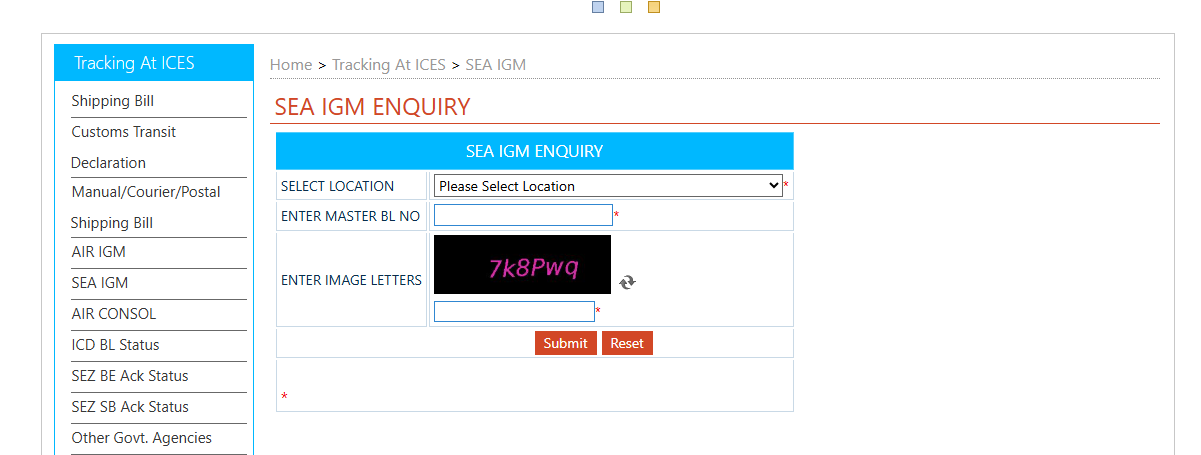
Step 2: Go to Services and click on Cargo Tracking/ IGM search/ Vessel & Cargo Tracking.
Search with a unique IGM number, bill of lading number or port code.
Step 3: Enter shipment details and search for the status.
Step 4: View IGM status and check for the readiness of Bill of Entry details.
Types of Sea IGM Status on ICEGATE Portal
Status Codes will be displayed, such as:
- ADC – Approved Discharge Completed
- SEC – Secured
- HLD – Hold by customers for verification
- DIS – Discharged at port
- PENDING
- VALIDATED
- APPROVED
- REJECTED
Benefits of Tracking Sea IGM Status
Tracking of Sea IGM status allows the importers, customs officers, and other stakeholders to monitor whether the cargo has been correctly filed, accepted, and recorded in customs, which ensures a timely and smooth importing mechanism.
Here are some key benefits that can be derived from tracking the Sea IGM status:
- Benefits to the Importer
- Tracking confirms that the goods are officially reported to Customs
- It helps in the preparation of the Bill of Entry (BOE).
- Tracking the status can help avoid potential demurrages, detentions and other frauds.
- Benefits to the Customs Broker (CHA- Customs House Agent)
- Status tracking brings coordination between the importer and the customs broker.
- Tracking helps to identify errors in the early stages, before the beginning of shipping, and reduces the number of rejections due to BOE mismatch or other non-compliances.
- It helps in an efficient import shipment mechanism, along with increasing compliance with customs documentation.
- Benefits to the Shipping Line/ Carrier
- Tracking benefits to provide for pre-arrival cargo visibility, which helps in quicker processing of shipments and reaching the destinations faster.
- Tracking gives a proactive measure for the shipping lines to streamline customs clearances, along with smoother port operations, with better scheduling and avoiding port congestion.
- Status tracking also helps in taking enhanced security measures for high-risk associated goods, take pre safety measures, reducing breaches and functioning smoothly.
- Benefits to the Government
- Tracking helps the government to analyse the import data before even the vessel arrives in India, flag high-risk shipments and prevent imports of smuggled, illegal or hazardous goods.
- Governments can use the IGM data to understand trade flows, the trends of imports, and monitor the economic factors involved in processing an import transaction and assess its viability.
- The status tracking facility provides complete details on all the cargo entering the country, giving government authorities complete cargo visibility and a track of the volume of imports.
Importers and carriers that fully comprehend the Import General Manifest (IGM) can ensure compliance, avoid delays, and better manage the import process. All supply chain participants gain from a well-prepared IGM since it expedites customs clearance.
Frequently Asked Questions


Clear offers taxation & financial solutions to individuals, businesses, organizations & chartered accountants in India. Clear serves 1.5+ Million happy customers, 20000+ CAs & tax experts & 10000+ businesses across India.
Efiling Income Tax Returns(ITR) is made easy with Clear platform. Just upload your form 16, claim your deductions and get your acknowledgment number online. You can efile income tax return on your income from salary, house property, capital gains, business & profession and income from other sources. Further you can also file TDS returns, generate Form-16, use our Tax Calculator software, claim HRA, check refund status and generate rent receipts for Income Tax Filing.
CAs, experts and businesses can get GST ready with Clear GST software & certification course. Our GST Software helps CAs, tax experts & business to manage returns & invoices in an easy manner. Our Goods & Services Tax course includes tutorial videos, guides and expert assistance to help you in mastering Goods and Services Tax. Clear can also help you in getting your business registered for Goods & Services Tax Law.
Save taxes with Clear by investing in tax saving mutual funds (ELSS) online. Our experts suggest the best funds and you can get high returns by investing directly or through SIP. Download Black by ClearTax App to file returns from your mobile phone.
Office Address - Defmacro Software Private Limited, C 245A, Ground floor, Room No 1, Vikas Puri, West Delhi, New Delhi, Delhi 110018, India
Cleartax is a product by Defmacro Software Pvt. Ltd.

ISO 27001
Data Center

SSL Certified Site
128-bit encryption