 Call Now
Budget 2026 Highlights: Key Takeaways, PDF Download, Important Points
The Union Budget 2026, presented by Finance Minister Nirmala Sitharaman on 1 February 2026, focuses on accelerating economic growth, improving tax compliance, boosting infrastructure investment, and supporting sectors such as MSMEs, manufacturing, railways, semiconductors, and artificial intelligence.
This article covers all the important Budget 2026 highlights, tax proposals, sector-wise announcements, and areas that have impact due to the changes.
Budget 2026 - Important Updates
Particulars Budget 2026 Announcement Infrastructure Capex ₹12.2 lakh crore Income Tax Slabs No change Revised Return Deadline Extended to 31 March Non-Audit Business ITR Due Date Extended to 31 August Defence Allocation ₹7.85 lakh crore Focus Areas Infrastructure, MSMEs, AI, Semiconductors, Railways New Income Tax Act Effective from 1 April 2026
1. Three Kartavyas - Main Duties to Citizens
The Union Budget 2026 focusses on three kartavyas, (refers to responsibility or moral obligation of the Indian Governement to the citizens of India
- Accelerating and sustaining economic growth
- Fulfilling citizens' aspirations
- Ensuring inclusive development (Sabka Saath, Sabka Vikas)
2. Direct Tax Proposals
Budget 2026 Highlights on Income Tax
Area of Change | Proposals | Stakeholders impacted |
| Income tax slabs | No change in slabs/rates | Everyone |
| ITR due date (non-audit) | Due date moved to 31 Aug (ITR-3/4, non-audit) | Freelancers, business owners, traders |
| Revised return deadline | Revised return allowed till 31 Mar (late fee after 31 Dec) | Anyone who needs to correct ITR |
| TCS (Remittance for educational and medical purposes under LRS+ overseas tour) | TCS reduced to 2% for key LRS/tour categories | Families sending money abroad, travellers |
| SGB tax (secondary market) | Tax-free redemption benefit only for original subscribers | SGB investors |
| STT increase | STT increased on sale of futures and options (separate STT rates for intrinsic price and option premium) | Traders, equity investors/promoters |
i. Extension of Due Date for Non-Audit Taxpayers
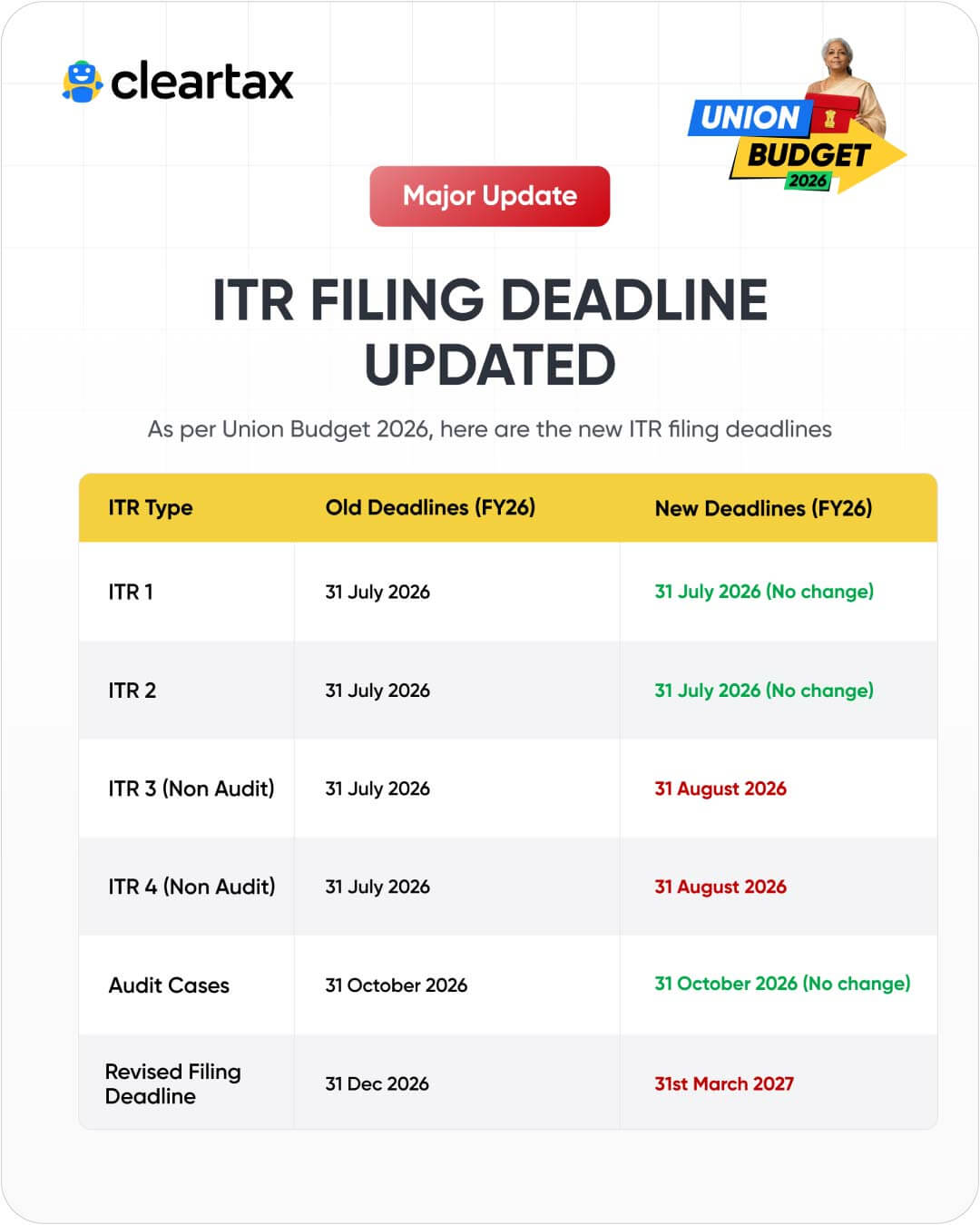
- For non-audit taxpayers except those who file ITR 1 and ITR 2, the due date for filing ITR is extended to 31st August. This extension is applicable from FY 2025-26 (AY 2026-27).
- Simply put, the due dates for ITR-3 and ITR-4 have been extended to 31st August.
- For the upcoming assessment year, the due date for such taxpayers is 31st August 2026.
ii. Extension of Revised Return Due Date
- The due date for the revised ITR has been extended to 31st March from 31st December.
- However, if you file the revised return after 31st December, the following late fees are applicable:
Income Level | Late Fee |
| Up to Rs. 5 lakh | Rs. 1000 |
| More than Rs. 5 lakh | RS. 5000 |
- These changes are applicable from 01st April 2026.
iii. STT Changes
Contrary to expectations, the Securities Transaction Tax (STT) is proposed to be increased for selected securities. The proposed changes in STT are given in the table below:
Security | Present Rate | Proposed Rate |
| Futures | 0.02% | 0.05% |
| Options premium | 0.10% | 0.15% |
| Options exercise | 0.13% | 0.15% |
iv. Taxation of Sovereign Gold Bonds
- Sovereign Gold Bonds are not taxable if they are redeemed. Every SGB holder is eligible for redemption from 5th year.
- This budget has added an additional condition, that the bonds should be originally subscribed for availing this benefit of tax exclusion.
- SGBs that are purchased during the tenure are not eligible for this tax exclusion.
- Simply speaking, from the upcoming tax year, SGBs are exlcuded from capital gain taxes only if they are originally subscribed and held till redemption.
- However, interest on SGBs are still taxable.
v. Removal of Interest Deduction against Dividend
- 20% deduction available against dividend income and units of mutual funds are removed. From now, on the dividend and income from mutual fund units are fully taxable, under the head income from other sources.
vi. TCS Rate Changes
The following table shows the present and proposed TCS rates.
Specified goods | Present Rate | Proposed rate |
| Alcoholic liquor for human consumption | 1% | 2% |
| Tendu Leaves | 1% | 2% |
| Scrap | 1% | 2% |
| Education and medical remittances above Rs 10 lakhs under LRS | 5% | 2% |
| Remittance for Overseas tour package program | 5% up to Rs 10 lakh, and 20% exceeding Rs 10 Lakhs | 2% for all remittances |
vii. Form 15G and 15H Changes
- Lower Tax Deduction Certificates (Form 15G and 15H) under section 395 of the Income Tax Act 2025 can now be applied for electronically. Previously, certain states have enabled online applications for LTDC.
- Also, persons can submit their lower tax declarations to the depositories directly (e.g., CDSL, NSDL) for lower TDS deduction on interest, dividends, and income from mutual fund units.
- The declaration will be forwarded to all companies and entities that pay the investors.
- Previously, taxpayers were required to submit the certificate to every fund house and other payers. To avoid this cumbersome process amendment has been made to section 393(6) of the Income Tax Act 2025.
- Supply of manpower is subject to TDS for works contracts, not as fees for providing technical services.
viii. Buyback Provisions
- Currently, all the sale proceeds from the sale of shares on buyback is treated as dividend income.
- As per the budget amendments, share sales on buyback is taxed under capital gains.
- For promoters, an additional buyback tax is levied. This will make the effective tax outgo for buyback transactions at 22% for corporate promoters and 30% for non-corporate promoters.
ix. TDS Procedural Changes
- Presently, when an NRI sells immovable property, the buyer must apply for a TAN and deduct TDS under section 194IA for the transaction.
- As per the Budget 2026 changes, the buyer is no longer required to apply for a TAN; they can now obtain a PAN-based challan and fulfil the TDS requirements.
x. Foreign Asset Disclosure Scheme for Small Taxpayers
- All residents owning foreign assets, including movable and immovable property, bank balances, etc., must fulfil the foreign asset disclosure requirements as laid down in the act.
- However, small taxpayers, such as former students with dormant foreign bank accounts and ESOP and RSU holders of foreign companies, failed to comply with the requirements due to inadvertence.
- A scheme has been proposed under the Finance Bill 2026, nudging non-compliant small taxpayers to provide their foreign asset disclosures as per the provisions of the act.
This scheme is divided into two parts, Part-A and B.
- Part A applies to taxpayers who did not make the foreign asset disclosure and income whose limit does not exceed Rs 1 crore rupees.
- For these cases, 30% of the value of assets and income not disclosed, and a 100% of additional tax needs to be paid.
- Part B deals with cases wherein foreign income is disclosed and taxed, while the corresponding foreign assets are not disclosed.
- In such cases, the default quantum should not exceed Rs 5 crore, and a fee of Rs 1 lakh needs to be paid.
xi. Tax Holiday for Non-Residents and Foreign Companies
- Until 2047, all foreign companies that render cloud services using data centres located in India are tax-exempt to the extent of income arising in India.
- A non-resident expert who stays in India for more than 5 consecutive years may be tax-exempt, provided that his or her stay is for a purpose related to a Central Government-notified scheme.
- The Minimum Alternative Tax (MAT) is exempt for all non-residents who pay taxes under the presumptive scheme.
xii. IFSC Exemptions
- For all the Overseas Banking Units (OBUs) situated in Special Economic Zone (SEZ) , the tax holiday is extended to 20 years, from the current limit of 10 years.
- For IFSC units, a tax holiday of 20 years out of 25 consecutive years shall be allowed. This is an extension from the current limit of 10 out of 15 years.
xiii. Other Important Amendments
- Motor Accidents Claims Tribunal: interest on compensation received is exempt; no TDS is required on the same.
- The Income Computation and Disclosure Standard (ICDS) requirements are now to be incorporated in the Indian Accounting Standards (IND AS) itself. The requirement of ICDS will be scrapped with effect from the tax year 2027-28.
3. MSMEs & Enterprises
- A ₹10,000 crore SME Growth Fund is proposed to support high-potential MSMEs and create “Champion SMEs”.
- The Self-Reliant India Fund (set up in 2021) is proposed to be topped up by ₹2,000 crore to continue supporting micro enterprises with risk capital.
- TReDS reforms are proposed to improve MSME liquidity, including mandatory usage by CPSEs and credit guarantee support for invoice discounting.
4. Banking & Financial Sector
- A High-Level Committee on Banking for Viksit Bharat is proposed to review and align banking sector reforms with India’s next phase of growth.
- NBFC reforms are proposed, including the restructuring of Power Finance Corporation (PFC) and Rural Electrification Corporation (REC) to improve scale and operational efficiency.
- Measures are proposed to deepen the corporate bond and municipal bond markets to support long-term financing.
5. Agriculture & Rural Economy
- New programmes are proposed to promote high-value crops such as coconut, cocoa, cashew, sandalwood, and nuts to improve farmer incomes.
- An AI-enabled agricultural advisory platform (Bharat-VISTAAR) is proposed to support farm decision-making.
6. Infrastructure & Connectivity
- Public capital expenditure is proposed to increase to ₹12.2 lakh crore in FY 2026–27.
- Expansion of freight corridors and national waterways is proposed to reduce logistics costs and improve market integration.
- City Economic Regions are proposed to strengthen city-led growth and regional development.
- Seven high speed rail corridors are proposed to be established, connecting major cities like Hyderbad, Bangalore, Chennai, Delhi, etc.
7. Other Sectoral Highlights
Tourism, Culture & Sports
Proposals are announced to strengthen tourism infrastructure, develop archaeological and cultural sites, and scale up the sports ecosystem through a long-term mission approach.
Services, Skills & Employment
- A High-Powered ‘Education to Employment and Enterprise’ Standing Committee is proposed to strengthen services-sector jobs, skills, and exports.
- Sector-specific skilling initiatives are proposed across healthcare, tourism, AVGC, and design.
Union Budget 2026 presents sector-wise highlights covering new schemes, policy reforms, and priority areas across the economy.
8. Indirect Taxes Changes
i. GST – Structural Tightening Without Rate Noise
Budget 2026 does not introduce headline GST changes as expected, but it deepens the system-first approach to GST enforcement. Amendments under the Finance Bill strengthen Central Goods and Service Tax (CGST) provisions around valuation, credit adjustments, refunds, and appellate mechanisms-
Post-sales Discount
- Section 15 is amended, due to which there is no need to link the post sale discount to an agreement or credit note when the ITC is already reversed.
Linkage of CDNs with invoices
- Section 34 is amended, tightening conditions for issuance, reporting, and linking credit notes and debit notes to original invoices, especially when adjustments affect tax liability or input tax credit.
Amendments on Refunds
- Section 54 has been amended in two important ways:
- Inverted Duty Structure refunds are now eligible for provisional refunds, improving cash flow while the final refund is processed.
- The minimum refund threshold for exports made on payment of GST has been removed, allowing exporters to claim refunds without being constrained by a monetary floor.
Advance Rulings & Related Conflicts
- Amendments made in section 10A strengthen the role of the National Appellate Authority for Advance Ruling in resolving conflicting advance rulings.
- Primary focus is on such advance rulings issued by State Authorities in cases involving the same applicant or identical questions.
- This amendment reinforces NAAAR as the final authority for ensuring uniformity in GST interpretation.
Amendment of Section 13 of the IGST Act
- The special rule for intermediary services is being removed, thereby the place of supply to be determined by general rule.
The changes are applicable from 1st April 2026, subject to notification by the CBIC.
ii. Customs – Strategic Enforcement Aligned to Manufacturing Policy
On the Indian Customs side, Budget 2026 reinforces India’s manufacturing and supply-chain localisation agenda. While tariff rationalisation continues to support domestic production, enforcement around classification, valuation, and exemptions is expected to tighten.
Simplification of Tariff Structure
- The tariff structure is proposed to be simplified to reduce complexity, correct duty inversion, and improve export competitiveness while supporting domestic manufacturing.
Removal of Customs Duty Exemptions
- Certain exemptions are proposed to be withdrawn for goods now manufactured domestically or where import volumes are insignificant, to rationalise the exemption framework.
Incorporation of Effective Rates in the Tariff
- Effective customs duty rates are proposed to be built directly into the tariff schedule, reducing dependence on separate exemption notifications.
Seafood Export Inputs
- The duty-free import limit for specified seafood processing inputs is proposed to be increased from 1% to 3% of the previous year’s FOB export turnover.
Fish caught by Indian Vessels
- In the Exclusive Economic Zone (EEZ) or on the high seas are made duty-free, with landing at foreign ports treated as an export of goods.
Leather, Textile, and Garment Exports – Time Extension
- The export time limit for final products is proposed to be extended from six months to one year for leather, textile garments, footwear, and related products.
Expansion of duty-free Imports for Leather and Footwear
- Duty-free import benefits for specified inputs are proposed to be extended to additional export categories in the leather and synthetic footwear sectors.
Battery Energy Storage Systems (BESS)
- The basic customs duty exemption on capital goods for lithium-ion cell manufacturing is proposed to be extended to BESS as well.
Solar Manufacturing Inputs
- Basic customs duty is proposed to be exempted on sodium antimonate, a key input used in the manufacture of solar glass.
Nuclear Power Projects
- The existing customs duty exemption for nuclear power project imports is proposed to be extended till 2035 and made applicable to all nuclear plants, irrespective of capacity.
Critical Minerals Processing
- A customs duty exemption is proposed on capital goods imported for processing critical minerals within India, supporting domestic value addition.
Biogas blended CNG
- The entire value of biogas is proposed to be excluded from the computation of the central excise duty on biogas-blended CNG.
Civilian Aircraft Manufacturing
- Basic customs duty is proposed to be exempted on components and parts required for manufacturing civilian training and other aircraft.
Defence MRO (Maintenance, Repair, and Overhaul)
- A customs duty exemption is proposed for raw materials imported for the manufacture of aircraft parts used in defence MRO operations.
Microwave Oven Manufacturing
- Basic customs duty is proposed to be exempted on specified parts used in the manufacturing of microwave ovens to deepen domestic value addition.
Validity of advance rulings under Customs extended from three years to five years, improving certainty for importers and exporters.
The changes are applicable from 1st April 2026, subject to notification by the CBIC.
Full List of Costlier and Cheaper Items
Items Becoming Cheaper | |||
Category | Item | Customs Duty Change | Impact |
Healthcare | Cancer & Rare Disease Drugs | Basic Customs Duty (BCD) is fully exempt for 17 cancer drugs and 7 rare diseases. | Significant reduction in treatment costs for patients. |
Travel & Study | Foreign Tour Packages | TCS reduced from 5–20% down to 2% (without any threshold). | Cheaper international holidays and upfront booking costs. |
Electronics | Mobile Phones & Tablets | Reduced duties on specific components and capital goods. | Lower retail prices for Made-in-India smartphones. |
Electronics (Household Appliances) | Microwave Ovens | BCD is exempted from specified parts/components. | Reduced production and purchase costs for kitchen appliances. |
Clean Energy | EV Batteries & Solar Panels | BCD exempt on Li-ion cells and solar glass ingredients (Sodium Antimonate). | Cheaper Electric Vehicles and solar energy installations. |
Aviation | Civilian Aircraft Components | BCD is fully exempt from parts for manufacture and MRO. | Boost to domestic aircraft manufacturing and lower maintenance costs. |
Exports | Leather & Textiles | Duty-free imports of inputs for Shoe Uppers and technical textiles. | Cheaper raw materials for footwear and garment exporters. |
Consumer Goods | Personal Imports | BCD slashed from 20% to 10%. | Lower costs for items ordered from abroad for personal use. |
Seafood | Shrimp & Fish Feed | Duty-free import limit for inputs raised from 1% to 3%. | Reduced costs for the marine export industry. |
Items Becoming Costlier | |||
Category | Item | Customs Duty Change | Impact |
Trading | Stock Market Transactions | STT hiked to 0.05% on Futures and 0.15% on Options. | Higher cost for retail traders in the F&O segment. |
Luxury Goods | Imported Watches & Alcohol | Rationalisation of duties/Excise hikes on high-end imports. | Increased prices for premium luxury brands. |
Sin Goods | Tobacco & Cigarettes | Hike in National Calamity Contingent Duty (NCCD) or Excise. | Higher retail prices for cigarettes and pan masala. |
Home/Kitchen | Coffee Machines | Removal of existing BCD exemptions on roasting/brewing units. | Higher cost for imported professional coffee equipment. |
Agriculture | Specific Fertilizers | Removal of import fee exemptions on Ammonium Phosphate. | Potentially higher costs for certain manure and complex fertilisers. |
Photography | Imported Cameras/Equipment | Duty increases on specific filming and sound recording equipment. | Higher costs for high-end professional imported gear. |
Budget 2026 PDF Download
- Download the Union Budget 2026 speech
- Download the Union Budget 2026 Highlights
Conclusion
The budget 2026 primarily focused on economic security, self reliance, and indigenous development, with focus on simplification and better compliance.
Frequently Asked Questions



Cleartax is a product by Defmacro Software Pvt. Ltd.

ISO 27001
Data Center

SSL Certified Site
128-bit encryption